

Artice PART1 | Part 2 | PART3 |
PODCAST Deep Dive
[Article Reading Time 15 mins ]
Preface | Why I Wrote This Trilogy
This isn’t just about political commentary; it is about discerning the times and understanding where history is driving us.
Recently, tensions around the Taiwan Strait have spiked—from the Japanese PM’s bold stance to China’s maneuvers, the US’s rapid positioning, and Russia stirring in the north. The eyes of the world are fixed on this island.
But geopolitical headlines only tell us the “what." They don’t answer the deeper questions: Why now? Why Taiwan? Why is this shaking happening all at once? And why must the Church awaken at this very hour?
This trilogy aims to unveil the invisible threads behind the visible chaos.
Part 1 | The Taiwan Strait: The Epicenter of East Asia
I. “A Taiwan Emergency is a Japan Emergency"
The midnight sea is always quiet, but silence often veils the deepest undercurrents.
When Japan’s new Prime Minister, Sanae Takaichi, declared, “A Taiwan emergency is a Japan emergency," it sounded like diplomatic rhetoric. But like a stone cast into the East China Sea, the ripples were instant and far-reaching.
China retaliated with fierce protests. Japan shook internally. The US Indo-Pacific strategy solidified overnight. And Taiwan, once again, stood at the center of the global stage.
This single statement forced Asia to wake up.
On the surface, Takaichi’s stance is no surprise; she has long been a hawk on national security. But this wasn’t just an expression of “friendship" or political posturing.
Her words pierced the veil of East Asia’s deepest reality: The Taiwan Strait is not just a regional issue; it is the absolute bottom line for Asian security.
And Japan has now publicly acknowledged this. It is a declaration that:
- If fire breaks out in the Strait, Japan cannot remain on the sidelines.
- China’s military expansion is now a direct existential threat to Japan.
- The US Indo-Pacific strategy will be triggered immediately.
- The entire security architecture of East Asia has shifted.
II. Behind China’s Backlash: Not Anger, but Exposure
China’s strike was swift and heavy. But the real issue wasn’t a “diplomatic red line"—it was the core narrative.
Once the link between Taiwan and Japan’s security is acknowledged, the game changes:
- Taiwan is no longer China’s “internal affair."
- Taiwan is no longer just a spot on the map.
- Every nation must reassess its safety.
- A threat to Taiwan = a diffused risk for all.
This is the truth China fears most: Taiwan’s destiny is too big to be contained. Takaichi didn’t just speak; she turned on the floodlights in the public square. And when the light comes on, hidden structures are instantly revealed.
III. Why is Japan Speaking Out Now?
This wasn’t an impulsive remark; it was truth forced out by a decade of pressure. From 2013 to 2024, Japan has faced a three-front survival crisis:
- (1) The North: Russia’s looming military pressure and the unresolved Northern Territories.
- (2) The West: China’s escalating incursions into the Miyako Strait and air defense zones.
- (3) The South: The realization that the Taiwan Strait is the actual “front line."
When these pressure lines converge, Japan no longer sees a “Taiwan problem"—it sees a “Japan problem." Takaichi was simply unveiling the reality of security to her people. The shaking of the Taiwan Strait shakes the very foundation of Japan.
IV. The Real Flashpoint: Not Japan, but the Strait
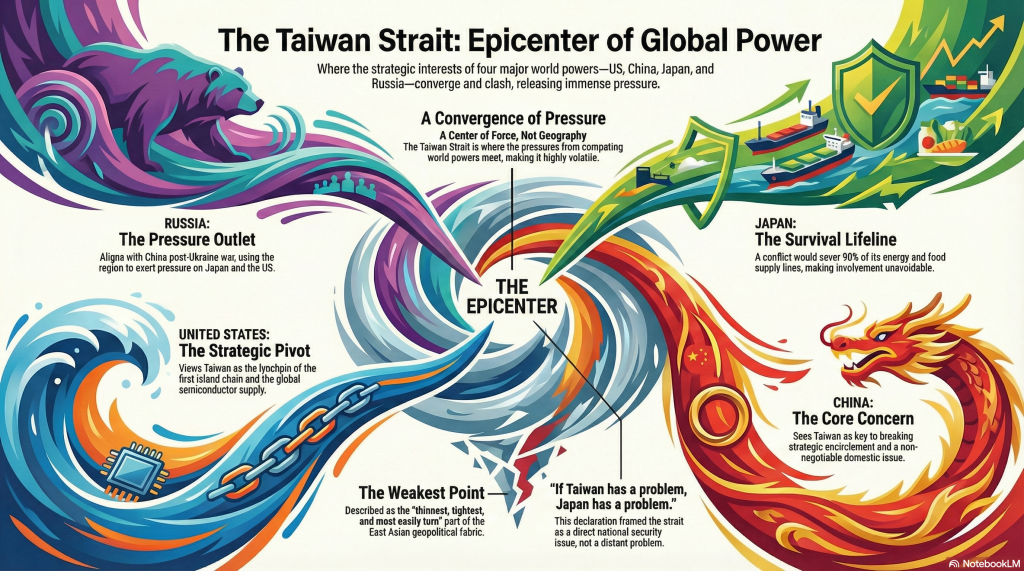
Imagine East Asia as a stretched fabric. Japan, China, the US, and Russia are four forces pulling in different directions. Taiwan is the thinnest, tightest, and most fragile point of that fabric.
This is why when Japan speaks, China hits back, the US watches, and Russia signals. The Strait is where these four powers collide.
1. The Strait = The Main Theater for US-China Contention
Since 2018, the US has been clear: Taiwan is the semiconductor heart, the spine of the First Island Chain, and the key to containing China’s rise. If the Strait is unstable, the giants will collide.
2. The Strait = Japan’s Lifeline
If conflict erupts:
- 90% of Japan’s energy and food supply lines are cut.
- Okinawa’s airspace becomes a war zone.
- Japan becomes a battlefield as US bases activate. It’s not about wanting to participate; it’s about being unable to escape.
3. The Strait = Russia’s Southern Pressure Valve
Since the Ukraine war, Russia has pivoted toward China. This forces Japan to look South—straight at Taiwan.
4. Taiwan’s Position: The Focal Point
Taiwan isn’t just “choosing a side"—it is caught in the crosshairs of every side.
- China’s Core Interest.
- The US Strategic Pivot.
- Japan’s Security Extension.
- Russia’s Pressure Point.
If you move even an inch, all four directions react. There is a word for this: Epicenter. You don’t need to move. You are the place where the world shakes, sounds, and trembles first.。
V. Why Did This Statement Ignite East Asia?
Because it forced everyone to admit a single fact: The Taiwan Strait is the “Epicenter" of Asia.
An epicenter isn’t necessarily the biggest or strongest place. What is it? It is where all the pressure concentrates and releases.
The Strait is exactly this:
- Four powers pressing in.
- Storylines converging.
- The turning point of the era.
Takaichi’s statement dragged Taiwan from “ambiguity" onto the “main stage." It transformed from a “neighbor’s issue" to the pivot of regional security. From the sidelines to the spotlight.
VI. What Does This Shift Mean for Taiwan?
1. Taiwan is Visible
We are not being provoked; we are being acknowledged. The Strait is recognized as the geopolitical key.
2. Taiwan is Positioned
We have been placed on the global chessboard. This brings pressure, but also opportunity. Your position is recognized, and your role is being re-measured.
3. Taiwan is Interlocked
Taiwan’s destiny is no longer just its own issue. If the Strait moves, the US, Japan, China, and Russia will feel it simultaneously.
4. Taiwan is Catalyzed
We are being pushed onto our own page of history. We didn’t seek the front lines; the front lines found us.
From this point on, Taiwan must possess an “Epicenter Mindset."
As Part 1 of this trilogy, I have focused on geopolitical discernment, not spiritual interpretation yet. But I must plant a seed here:
When great nations acknowledge your position, it is not a disaster. It is the times telling you: Your role has arrived.
And destiny rarely arrives with applause; it usually begins with a shaking.
The shaking of the Strait is not an accident. It is a storyline accumulating for years, now being pushed to the next page of history.
VII. Conclusion: This Is Not a Crisis, It Is an Awakening
East Asia has been jolted awake. Japan was forced to speak the truth. China’s reaction exposed its deep-seated anxiety. The US must now fully shoulder the Indo-Pacific architecture. Russia’s shadow is pressing down from the north.
And standing at the intersection of all these storylines is Taiwan—an island that seems small, yet can no longer be ignored.
Takaichi’s words rang like a bell—not just waking Japan, but the entire region: The Era of the Strait as the Epicenter has begun.
At this hour, Christians cannot be numb, nor can we remain silent. We must ask:
- Is the shaking of the Strait danger? Or a sign that our national destiny is turning?
- Is the encroachment of nations a threat? Or a catalyst pushing Taiwan toward maturity?
- And the Church—are we spectators? Or has God already placed us center stage?
These questions are not meant to create fear, but to help us discern: How earthly political shifts interlock with spiritual turning points.
This prepares us to step into the next chapter: <Part 2: Japan’s Choice and the Four-Front Pressure: How the Strait Became Asia’s Turning Point>


 望樓觀點
望樓觀點 
發表留言